

Finding Our Inner Glow Through Yoga Asanas

The evenings begin to fold in earlier. The sun sits lower in the sky. Light arrives at a slant, softer and more golden, then disappears before the day feels quite finished.
This seasonal shift can stir different things in us. Some people feel cosy and ready to turn inward. Others feel tired, flat, or resistant as the brightness of summer fades. The body notices the change before the mind has found words for it. Shoulders creep up. Breath becomes shallower. Energy starts to gather close to the centre.
Yoga gives us a way to meet that change without forcing ourselves to feel bright all the time. Through breath, attention, and asana, we can tend to our own warmth. We can move in a way that reminds the body there is still light within it.
This is the heart of Finding Our Inner Glow Through Yoga Asanas. Our glow is not performance, positivity, or constant energy. It is steadiness. It is presence. It is the quiet sense that something alive and luminous remains available, even as the outer world grows darker.
The light outside changes, and the body responds

Seasonal change is not only a visual experience. It shapes rhythm.
As the nights draw in, many of us naturally begin to slow down. We may crave warmer food, earlier nights, quieter plans, and softer spaces. This is not a failure of motivation. It is the body listening to the world around it.
Yoga has always worked with rhythm. The rhythm of the breath. The rhythm of effort and rest. The rhythm of expansion and return. When the sun is high and days feel wide, our practice may become more dynamic. When the light lowers, the practice may ask for something different.
That might mean:
Moving more slowly
Staying with each breath for longer
Choosing postures that build warmth without draining energy
Practising at dusk to mark the shift from day to evening
Letting rest become part of the practice, not an afterthought
The aim is not to fight the season. The aim is to stay connected to ourselves through it.
There is a particular beauty in a practice that meets the darker months with respect. It says, “I can generate warmth here. I can listen here. I can glow from the inside out.”
Inner glow is not a mood, it is a relationship with ourselves
We often talk about glow as something visible. Clear skin, bright eyes, an uplifted face, a certain spark. But the deeper glow begins before anything can be seen.
It begins in the way we inhabit the body.
When we practise yoga asanas with care, we create a conversation between the body and attention. We notice where we grip. We notice where we collapse. We notice which parts of us are asking to be strengthened and which parts are asking to be softened.
That listening creates warmth. Not only physical heat, though that may come too, but a sense of aliveness.
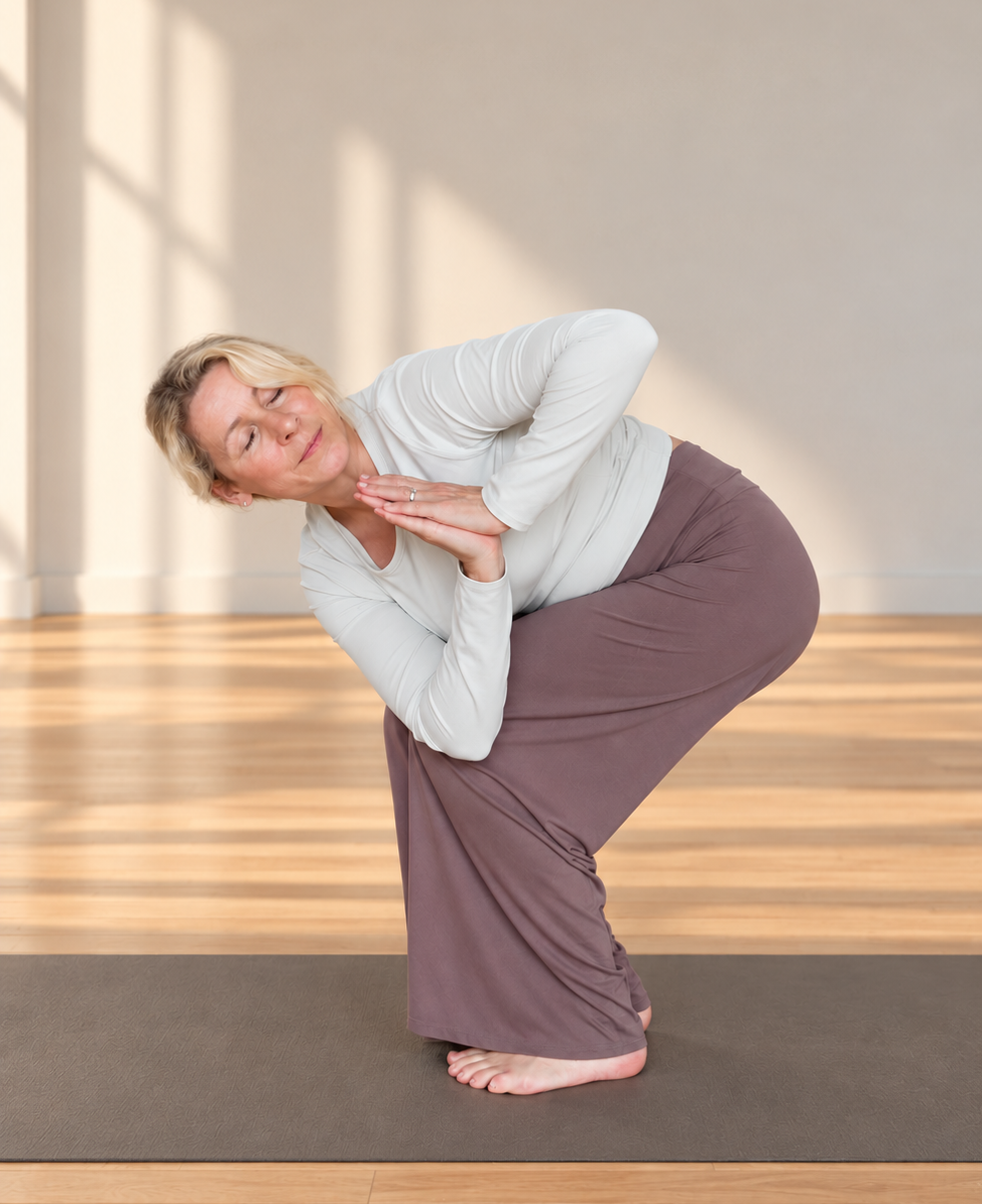
In this revolved Twisted Chair pose, thighs and glutes work while the twist involves thoracic spine and core. If you have back issues, a more gentler version is not to twist, but position self as though sitting in a chair, hold hands in prayer position and just focus on 2-3 rounds of breath, whilst feeling a sense of strength, steadiness and ease. This warms the core and legs up, creating an inner warmth and releasing toxins caught in cells within muscles.
In yoga philosophy, the idea of tapas is often described as heat, discipline, or inner fire. It does not need to mean pushing hard or chasing intensity. Tapas can be the quiet commitment to return to the mat when the room is dim and the mind is scattered. It can be the choice to breathe steadily in a posture rather than rush through it.
Inner glow grows through small, repeated acts of presence.
A posture held with awareness can become a lantern. A slow breath can become a match struck in the dark. A practice does not need to be long to be sincere.
Asanas that kindle warmth and steadiness
The best practice for inner light is not always the most demanding one. A nourishing autumn or winter practice often combines grounding, gentle strength, mobility, and rest.
Before beginning, listen to your body. Move within a comfortable range, especially if you are managing injury, fatigue, pregnancy, illness, or pain. This post is for general information and reflection, not medical advice.
Mountain Pose helps us remember our centre

Tadasana, or Mountain Pose, can look simple from the outside. Standing. Feet rooted. Arms relaxed. Spine tall.
Yet it is one of the clearest ways to notice how present we are.
Stand with the feet hip-width apart or touching, whichever feels stable. Let the soles of the feet connect with the ground. Soften the knees slightly. Allow the tailbone to lengthen, the chest to widen, and the crown of the head to rise.
Take several breaths here.
Mountain Pose teaches that inner glow does not always begin with movement. Sometimes it begins with arrival. We come back into our shape. We feel the floor holding us. We let the body know, “I am here.”
Sun Salutations can bring light into the whole body
Sun Salutations are often associated with morning practice, but they can be beautiful at dusk too. As the outer sun lowers, the sequence becomes a way of honouring light rather than demanding it.
Move slowly through a few rounds. Let each breath lead each shape. If a full Sun Salutation feels too strong, keep it simple:
Stand in Mountain Pose.
Inhale and reach the arms up.
Exhale and fold forward with soft knees.
Inhale and lengthen the spine halfway.
Exhale and step back to a gentle plank or all fours.
Lower with control or move straight into Cobra.
Rise into Cobra or Upward-Facing Dog.
Press back into Downward-Facing Dog or Child’s Pose.
Step forward.
10. Return to standing.
The warmth comes from repetition, but also from attention. A slow round can be more illuminating than a fast one.
Let the practice feel like tending a fire. Enough movement to create heat. Enough breath to feed it. Enough awareness to keep it steady.
Warrior poses build courage without hardness
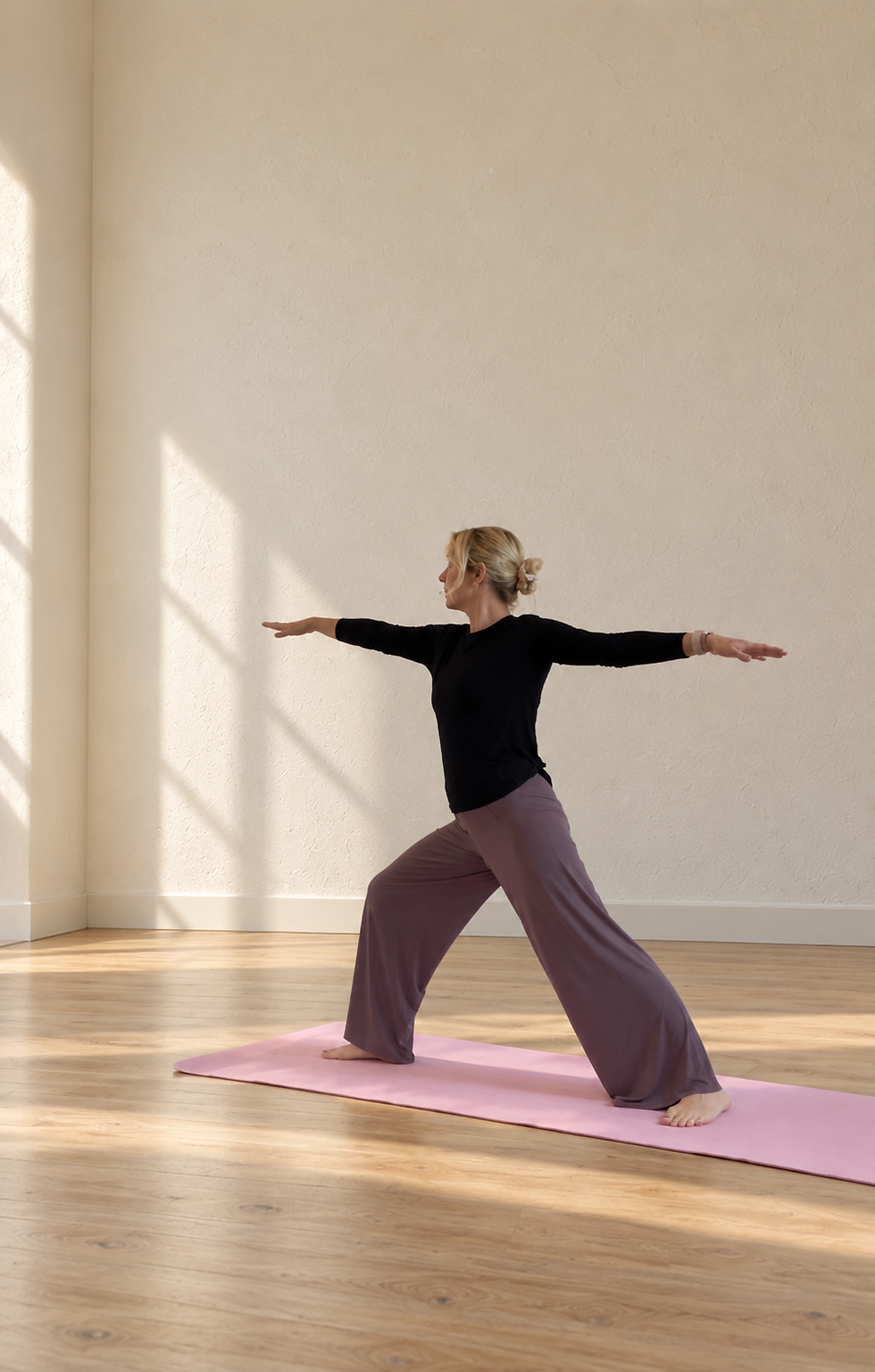
Virabhadrasana I and II, or Warrior I and Warrior II, are powerful postures for the darker part of the year. They ask the legs to root and the chest to stay open. They invite strength without closing the heart.
In Warrior II, step the feet wide. Turn one foot out and bend that knee over the ankle. Extend the arms in opposite directions. Let the gaze rest over the front hand.
There is something deeply steadying about this shape. The legs work. The breath continues. The torso stays spacious.
This is a useful reminder for seasonal transitions. We do not need to become rigid to feel strong. We can stand firmly and stay receptive.
Try holding Warrior II for three to five breaths on each side. Notice the effort in the legs. Notice whether the jaw tightens. Soften what does not need to work so hard.
That balance is part of the glow.
Twists help clear the stale places
As the season changes, the body can feel heavy or stagnant. Gentle twists can help us feel refreshed, especially when practised with breath and care.
A simple seated twist is enough.
Sit cross-legged or with the legs extended. Place one hand behind you and the other hand on the opposite thigh. Inhale to lengthen the spine. Exhale and turn gently.
Do not force the twist. Let the breath create space. Let the head turn last.
Twisting postures can feel like wringing out the day. They give the body a clear physical action, turn, pause, breathe, release. This can be helpful when the mind feels full or the mood feels dim.
After each side, return to centre and notice the difference. Often the glow is subtle. A little more space between the ribs. A smoother breath. A clearer sense of being here.
A simple sequence for the season of low light
A seasonal practice does not need to take an hour. Fifteen to twenty minutes can change the tone of an evening.
Here is a gentle sequence to support warmth, grounding, and inner brightness.
Begin with arrival
Sit or stand quietly for one minute. Let the eyes soften or close. Notice the breath without changing it.
Place one hand on the chest and one on the belly. Feel the body breathing itself.
Warm the spine
Move through Cat and Cow for five to eight rounds.
On the inhale, broaden the chest and lift the sitting bones. On the exhale, round the spine and draw the navel in. Let the movement stay slow and smooth.
Build gentle heat
Take three slow rounds of Sun Salutations. Modify freely. Use Child’s Pose whenever needed.
The point is not to complete a perfect sequence. The point is to wake the body kindly.
Stand in strength
Practise Warrior II on each side. Then move into Triangle Pose if it feels comfortable.
In Triangle, keep both legs steady and reach the front hand to the shin, a block, or the floor. Let the top arm rise if the shoulder agrees. Keep the breath broad.
Turn inward
Come down to the mat for a seated twist on each side. Follow with a forward fold, knees bent as much as needed.
Let the back body soften. Let the head release.
Rest with intention
End in Savasana or Constructive Rest, lying on the back with knees bent and feet on the floor.
Stay for at least three minutes. Imagine the warmth of the practice settling into the centre of the body. No need to visualise anything perfectly. Simply rest.
Keeping the glow alive beyond the mat
The asanas may begin the process, but inner light is kept alive through the way we carry practice into ordinary moments.
A low sun can teach us to value softer forms of brightness. Candlelight. A warm drink. A slower walk. A real pause before answering a message. A hand placed on the heart before sleep.
Yoga becomes more powerful when it stops being something we only do and becomes something we remember.
After practice, try asking:
What feels warmer in me now?
Where do I feel more space?
What can I carry gently into the rest of the day?
What would help me protect this inner light tonight?
These questions do not need big answers. They help turn attention toward the subtle shifts that practice creates.
It can also help to create a small seasonal ritual around your yoga. Roll out the mat before the room becomes too dark. Light a candle if it is safe to do so. Put on warm socks for Savasana. Keep a blanket nearby. Let the practice feel welcoming, not like another task waiting to be completed.
Consistency grows when the practice feels like care.
When energy is low, soften the practice
There will be days when the inner glow feels hidden. Yoga should not become another way to criticise yourself on those days.
If energy is low, reduce the effort. Lie with the legs resting on a chair. Practise Child’s Pose. Take a supported forward fold. Sit and breathe for five minutes.
A quiet practice still counts.
The glow does not disappear because the flame is small. In fact, a small flame often asks for more tenderness. Shield it from the wind. Feed it slowly. Stay close.
This is one of yoga’s kindest lessons. We do not have to earn rest. We do not have to shine brightly to be worthy of care.
Some evenings, the most powerful asana is the one that helps the nervous system settle. Some days, the practice is simply placing the body on the mat and letting the breath become steady again.

Let the season be a teacher
As the light changes outside, yoga invites us to notice the light within. Not as a bright performance. Not as endless energy. As a living warmth we can return to, tend, and trust.
Through asanas, we ground the feet, open the breath, strengthen the legs, soften the places that grip, and rest deeply enough to feel ourselves again. Each posture becomes a way of saying yes to presence. Each practice becomes a small act of remembering.
The nights may draw in. The sun may sit low. A new season may ask us to slow down.
Still, there is light here.
Roll out the mat. Stand tall. Breathe deeply. Move with care. Let your own glow rise from the inside.


Comments